Survey: 56% of AI enthusiasts (and a third of all users) tell chatbots things they keep from other people
However you feel about AI, it’s become a significant part of daily life for many. People use it, but should they trust it with their personal information? At DuckDuckGo we don’t think you should have to sacrifice your privacy to get the benefits of being online, AI included. We create tools to protect everything you do online, including searching, browsing, and chatting with AI.
We recently conducted a survey of nearly 2,000 U.S. adults to hear directly from you about AI: your biggest concerns, blind spots, and more. We unpack some of that research here.
Key Takeaway: People are sharing secrets that AI companies don’t keep.
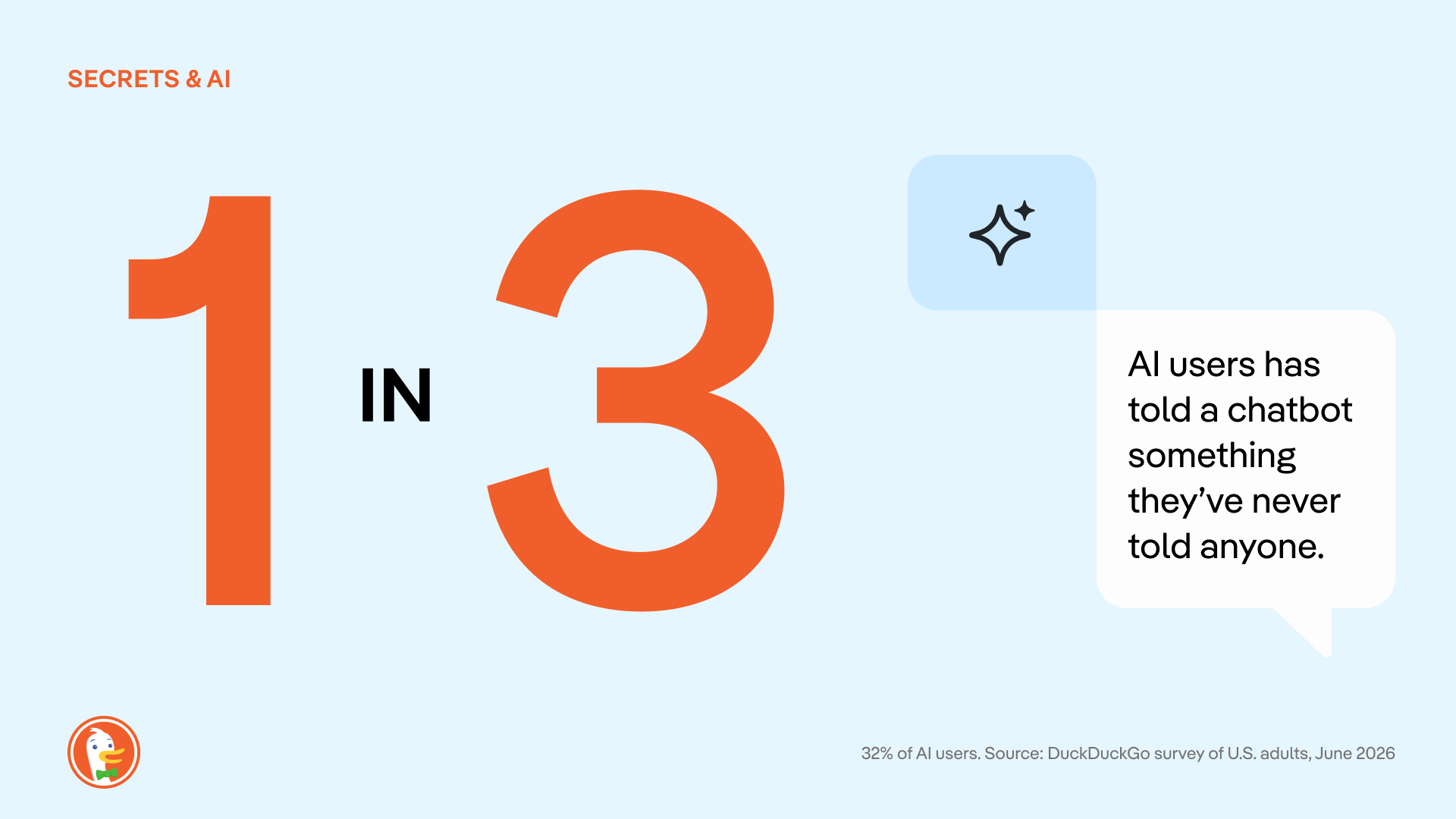
- 1 in 3 AI users say they’ve told an AI something they kept from trusted people in their lives.
- 32% of AI users have shared information that they kept from close friends, parents, or medical professionals. Among self-described AI enthusiasts who use chatbots, it’s as high as 56%.
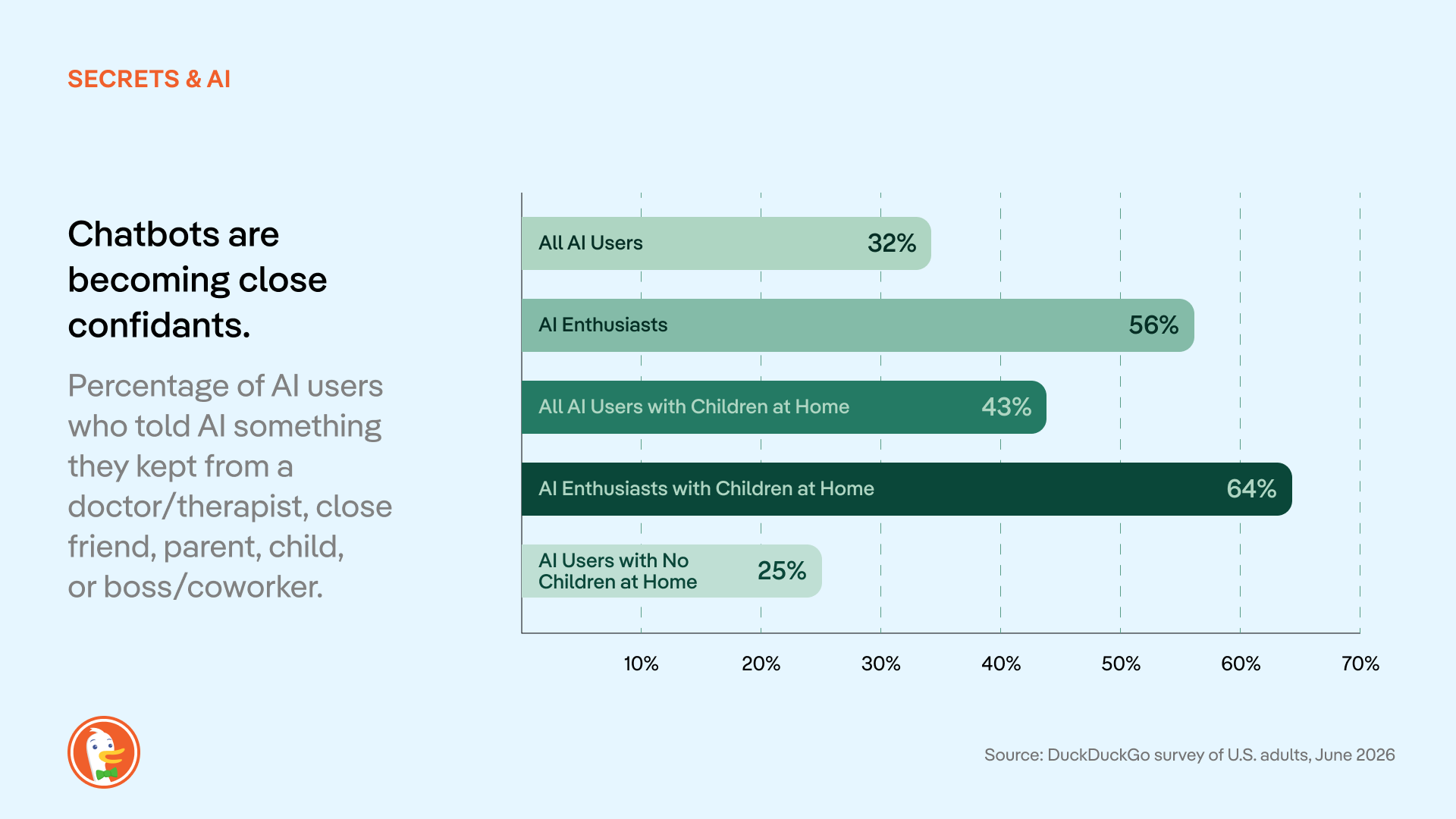
- Parents are confiding in AI almost twice as much as non-parents.
- Among parents who use AI, 43% have told an AI something they’ve never shared with another person. That number drops to 25% for AI users with no children at home.
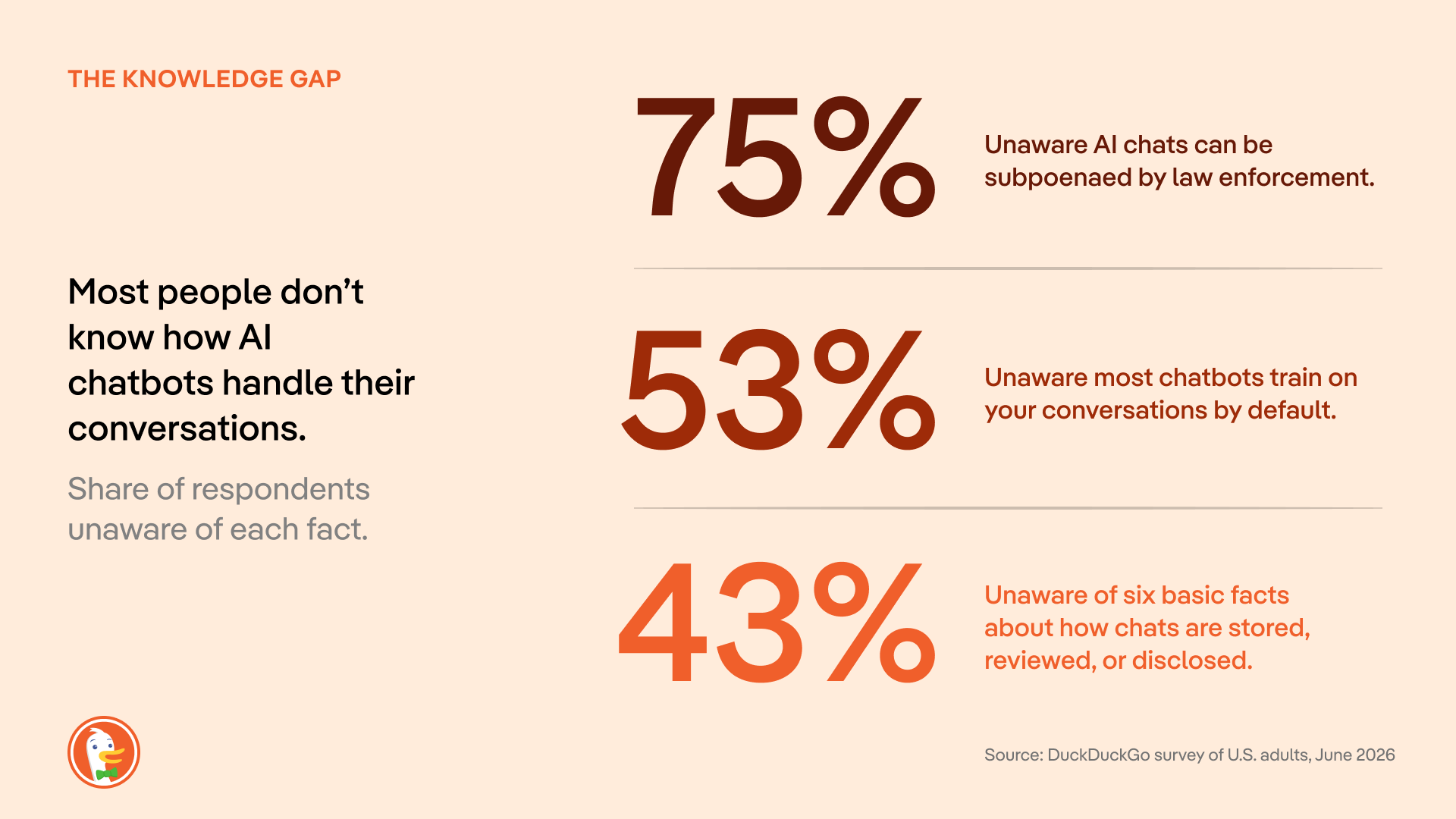
- Most people don't know how most AI companies handle their chats.
- 53% of respondents didn't know (or weren't sure) that most chatbots train on their conversations by default. Only 25% realized AI chats can be subpoenaed by law enforcement.
- 43% of people were unaware of six basic facts about how chats are stored, reviewed, or disclosed. That includes a third of self-described active AI users.
- Once people learn how most AI companies use their chats, most don't like it.
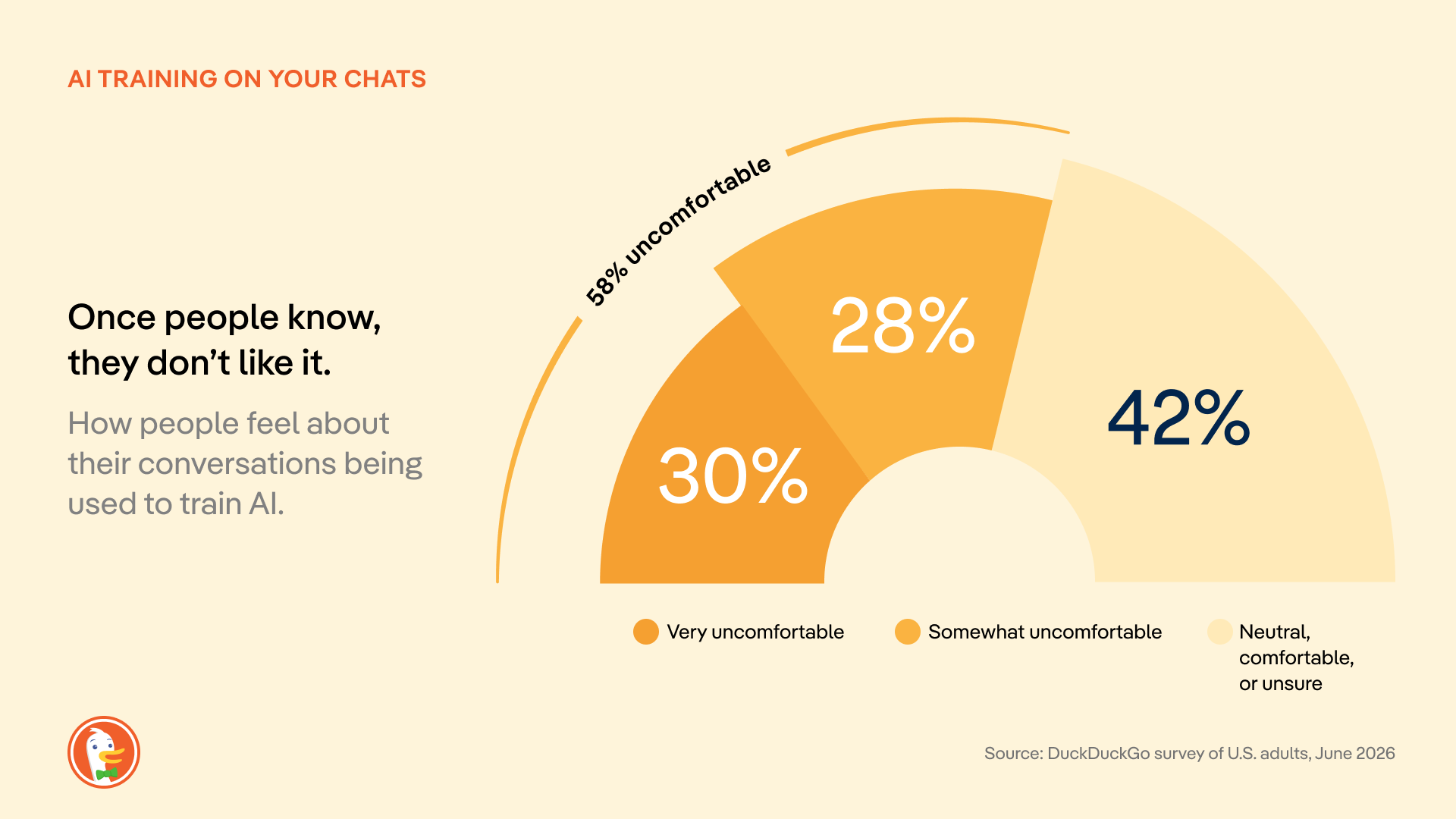
- 58% of people are uncomfortable with their conversations being used to train AI. 30% of respondents specified feeling “very uncomfortable.”
For better or worse, chatbots are becoming close confidants for many.
For many people, AI chatbots serve as a judgement-free space to share things they won’t tell anyone else. While a typical web search might be a few words, AI chat invites longer, more personal input. Search queries reveal interests, but AI conversations have the potential to reveal thought processes, communication styles, and more.
This is supported by our survey results. Among AI users, 32% said they’ve told a chatbot something they withheld from a close friend, parent, colleague, doctor or therapist. That number jumps to 56% for people who consider themselves AI enthusiasts. That’s a lot of people telling AI private things they haven’t shared even with trusted individuals.
One group seemingly more vulnerable to the overshare? Parents or guardians with children in the household.
Among all parents who use AI, 43% report that they’ve told an AI something they never told a doctor, therapist, close friend, parent or child. That’s almost twice as much than AI users with no kids at home (25%). And it’s not surprising; even AI CEOs talk about leaning on AI tools for parenting issues.
Conventional AI companies have leaned into this tendency, encouraging users to treat chatbots like confidants in their ad campaigns and media appearances. But these messages all rest on one assumption: That these chats are private. In most cases, that just isn’t true.
Most AI chat services use conversations for model training unless users actively opt out. Conversations are automatically tied to user profiles, stored by the AI companies, and potentially used for invasive behavioral advertising and shared with law enforcement. Beyond the privacy risks inherent in these tools, there have already been multiple data leaks where personal chats were made available to the public, revealing info like full names, addresses, and ID numbers connected to chat histories.
The more people know about AI privacy practices, the less they like it.
According to the survey, people are largely in the dark about the privacy problems built into most AI tools. (As with other forms of online tracking and surveillance, this is not anyone’s fault as an individual; rather, it’s an ongoing industry issue.)
We asked respondents if they knew these six basic facts about how conventional AI chats are stored, reviewed, and disclosed:
- AI chats can be subpoenaed by courts/law enforcement. (ex: CNN)
- AI chats can be made public in a lawsuit. (ex: TechCrunch)
- Employers can access work/enterprise AI accounts. (ex: Computer World)
- Settings to delete/stop storage vary by provider. (ex: CNBC, Washington Post)
- Free accounts often have weaker privacy than paid accounts. (ex: Axios)
- Human employees can review your chats. (ex: Fortune, TechCrunch)
According to our survey, these common AI privacy issues are not widely understood. 53% of people didn't know (or weren't sure) that their conversations are used for AI training. Only 25% knew that AI chats can be subpoenaed by the government. Across AI users and non-users alike, 43% didn’t know any of the above.
Once people know it’s happening, 58% of people are uncomfortable with how their conversations are being used to train AI. (30% specify “very uncomfortable.”)
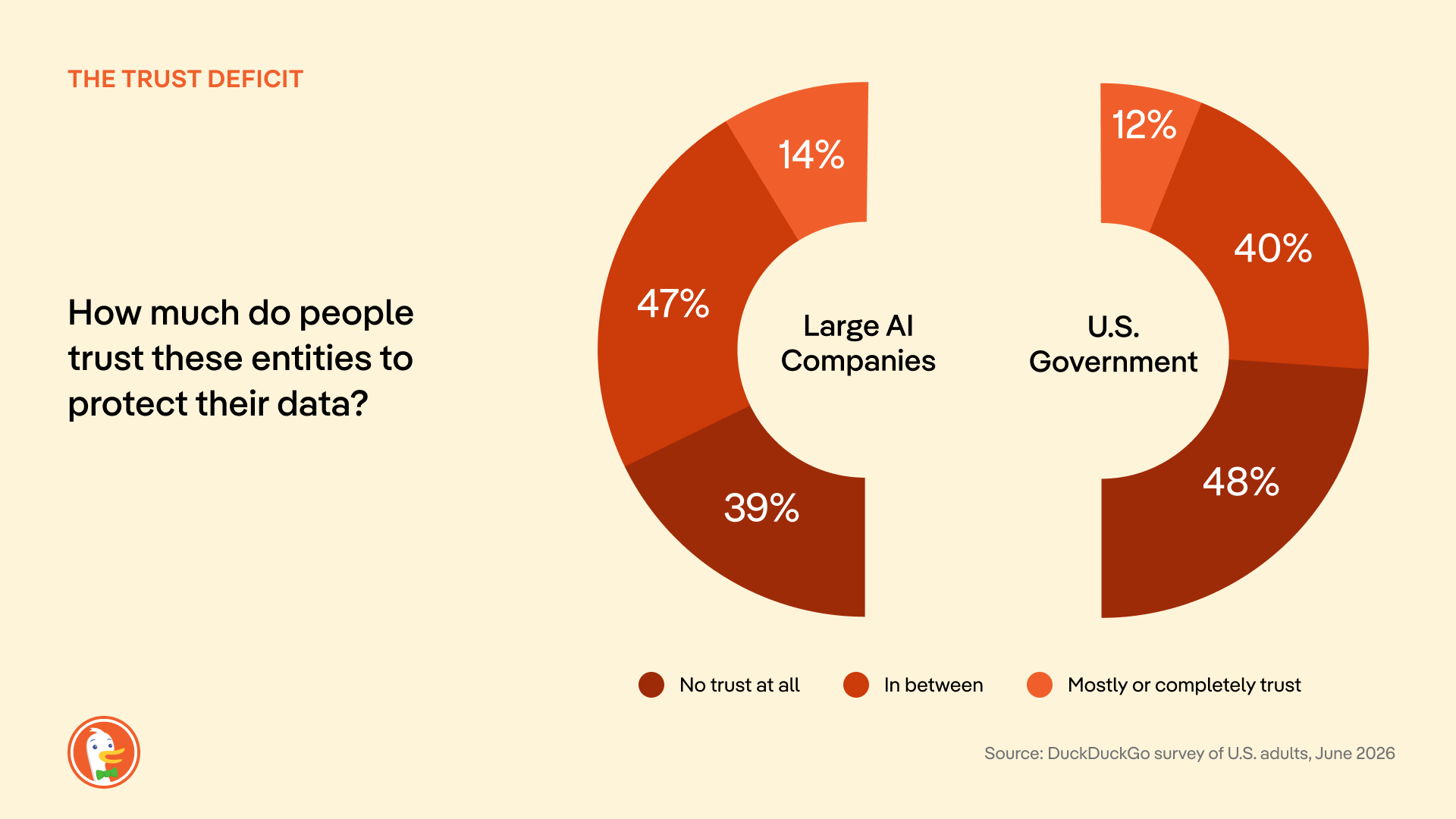
Only 14% of respondents “mostly” or “completely” trust large AI companies to protect their data; 39% have no trust at all. The U.S. government scores even worse: 48% have “no trust at all.”
Where do we go from here?
When we talk about online privacy in search engines and browsers, many people think “it’s too late, my information is already out there.” But the most valuable information you could share with Big Tech is your next question, not the questions you asked days or months or years ago. So, it’s never too late to make the switch to more private services online. And AI chat is still in its early days; most people haven’t formed habits with this technology yet, making it easier to act.
Until government regulations and industry norms catch up, there are proactive steps you can take to protect yourself while using AI chat. Start by seeking out AI tools with transparent data handling policies, designed with privacy in mind. (That’s why we built Duck.ai: free, anonymous access to multiple AI models from OpenAI, Anthropic, and more, all in one place. And we’ll never spy on your chats or store them in an invasive profile. Learn more in the strict Duck.ai Privacy Policy.)
Methodology
This survey was commissioned and conducted by DuckDuckGo. Responses were collected from 1,944 U.S. adults (18+) between June 17 and June 27, 2026, using an online sample sourced through the PureSpectrum panel. Quotas were applied to balance the sample to US Census demographics for age, gender, and region; results are reported unweighted. The margin of error for the full sample is approximately ±2.2 percentage points at the 95% confidence level, and larger for subgroups. (For example, the margin of error is about ±6 points for adults aged 18-24). Figures for open-ended questions, such as respondents' single biggest AI privacy concern, are based only on those who provided an answer. Percentages may not total 100% due to rounding or multiple-response questions.